Monday, April 9, 2012

Split Pea Soup


Last week, the weather in NYC suddenly dropped and I found myself pulling out my heavy winter coat again. I thought I had stashed it away once and for all, but it seems it isn't so. Since the winter has been extremely mild this year, I'm the first one to admit what a wimp I've become when it gets even slightly cold (the other night I was running through the streets freezing my bum off, only to learn it was in the low 40s. I could have sworn it was in the single digits!). To warm myself up I made this comforting split pea soup. Aaron was away over the weekend, and after eating at questionable establishments on the road, I thought a hearty warm soup would be just the ticket to restore his traveled-out bones. 


I've always loved split pea soup. I can remember as a child whenever my family would drive to southern California (in pursuit of Disneyland, no doubt) we would stop at Pea Soup Andersen's. These may have been the only times I ate it fresh, as I don't recall ever cooking it at home unless it was out of a can. The recipe I've provided below uses smoked ham hock, which imparts delightful smoky undertones to the soup. Ham hock, or pork knuckle, is a very cheap cut of meat (the lower portion of the the hog's leg, consisting of meat, fat, gristle, connective tissues and bone), but the rewards are plenty. You can easily find it at good quality butcher shops or specialty food stores, and many grocery stores will order it for you if you call ahead. You can always substitute the ham hock with leftover diced ham, but the bone provides that much-coveted flavor.  


I have a recipe from Jamie Oliver for a vegetable soup in which he places a poached egg on top. This looked so good and I knew the combination would be equally splendid with split pea soup. Not to mention make a lovely presentation. With some crusty bread and a glass of red wine, in my opinion, this hearty meal nears perfection. 

Sadly, and with much regret, I must admit we only enjoyed one day of this soup. Running late and in a rush, I stupidly left my apartment with the soup sitting out all night. Yes, that's right. I walked in the kitchen the following morning (16 hours later) and was devastated to see my yellow pot filled with soup still sitting on the stovetop. NOOOOOOO!!! I couldn't believe it, I had even cleared a spot for it in the fridge! I melted, swore a lot, and emptied the contents of the pot into the trash. I felt a lot better after punching the couch a couple of times to relieve my anger (I normally wouldn't have been so mad... but I've done this before!) I reminded myself that at least this soup was made of extremely cheap ingredients. Nevertheless, I hate it when food goes to waste. No use crying over spoiled soup, I said (cursing under my breath). The only thing that made me feel better was marching back into the kitchen and start cooking. 


SPLIT PEA SOUP
Adapted from Patricia Murray, Bon Appetit, May 1996 

2 tbsp. unsalted butter
1 large yellow onion, chopped
1 cup chopped peeled carrots
1 cup chopped celery
3 cloves garlic, minced
1½ lbs. smoked ham hocks, brought to room temperature 
2 tsp. dried marjoram or oregano
2 bay leaves
1 tsp. whole black peppercorns
1 lb. green split peas (about 2¼ cups) 
2 quarts chicken stock or water (8 cups), or 4 cups chicken stock and 4 cups water
Kosher salt and pepper to taste
A small spice bag or cheesecloth

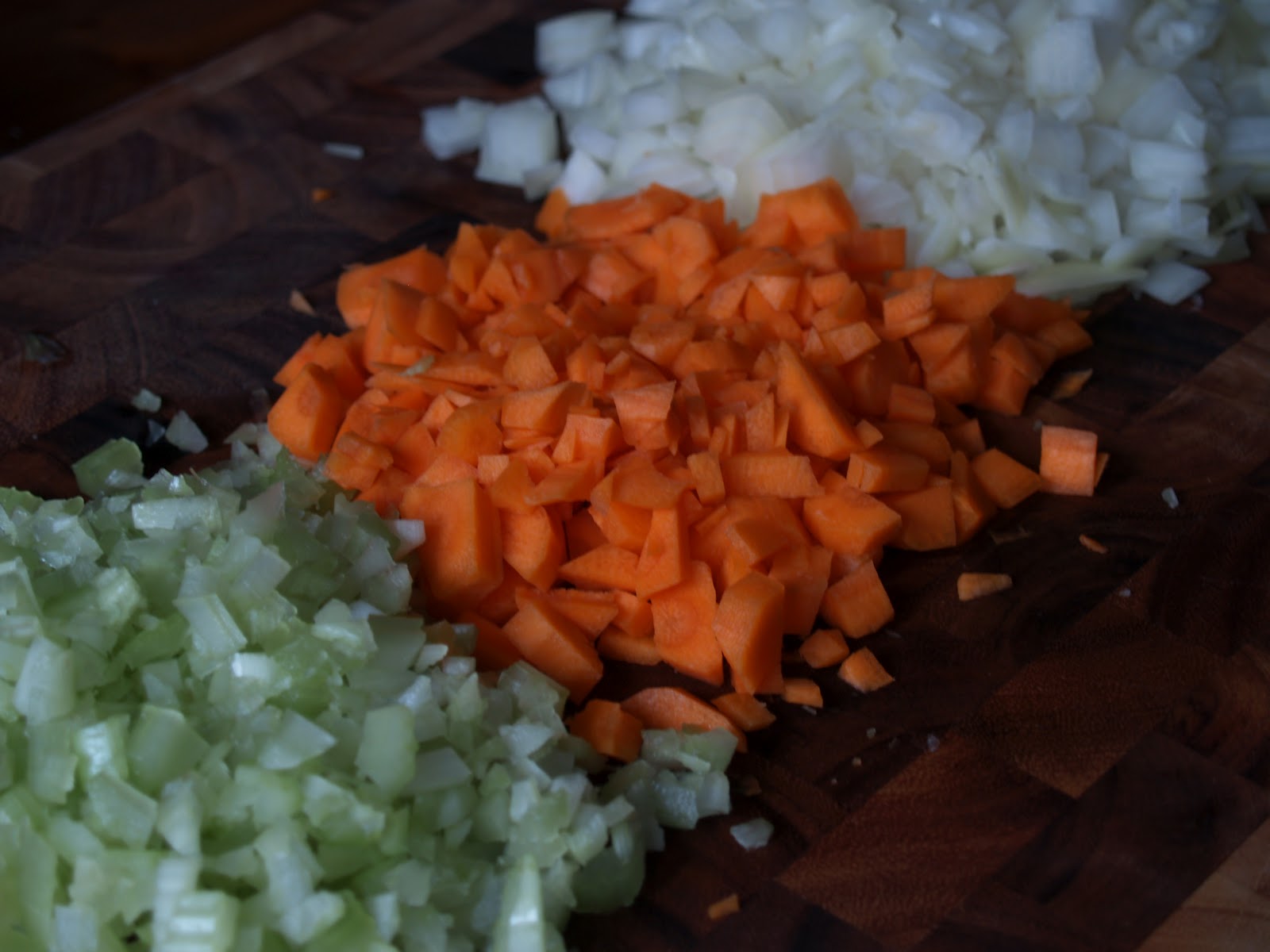
Start by placing the peppercorns and bay leaves in a spice bag or in a cheesecloth bundle tied with butcher's twine, and set aside. Melt the butter over medium heat in a large pot or Dutch oven. Add the onion, carrots, and celery, and sauté the vegetables until they become soft, about 8 minutes. Add the garlic, stir, and cook for a minute more. Place the ham hock in the pot, toss in the marjoram or oregano, and add the spice bag containing the peppercorns and bay leaves. Add the split peas and stock or water, stir the pot, and bring to a boil. Reduce heat to medium-low and cover the pot with the lid slightly ajar. Simmer for 2 hours, stirring every so often, and scrapping the bottom of the pot to avoid scorching. Flip the ham hock halfway through cooking.

Turn off the heat and transfer the ham hock to a bowl to cool slightly. Remove the spice bag and discard. Puree the soup using a stick blender (or puree in batches using a food processor or blender). Return the pureed soup to the pot. Season the soup with salt and pepper to taste, and keep warm over low heat. 

Cut the meat off the ham hock (it should pull right off the bone) and dice the meat. Ladle the soup into bowls and sprinkle with the diced ham. Garnish each bowl with grilled French bread brushed with olive oil and a poached egg (see notes below), if desired. 

Yield: about 6 servings

Notes:
  • If you prefer more ham in your soup, dice up some cooked thick-cut ham to add to the diced ham hock.
  • This soup freezes well. After defrosting, you may need to add a bit of water to thin it.
  • To poach the eggs (4 at a time), fill an 8 to 10-inch saucepan or deep skillet with 2½ to 3-inches of water. Add 1 tbsp. of white vinegar to the pan per quart of water used and 1 tsp. salt. Bring to a simmer. Break each of the eggs directly over the water, and let them fall in (sometimes I break each egg into a separate teacup before dropping them in the water to work more quickly). Maintain a simmer during the entire cooking process and do not let boil. Simmer the eggs for exactly 4 minutes and remove them using a slotted spoon, in the same order you placed them in the water (starting with the first egg). Immediately place the eggs in a bowl of ice water. The whites of the eggs should be set and the yolks should be soft when gently pushed with your finger. Cut off any stringy bits of egg white. Poach more eggs in the same manner. If making in advance, the eggs will keep well in a bowl of ice water in the refrigerator for several hours. If making the night before, drain the water and keep the eggs refrigerated in a well-sealed container. To reheat the eggs, place them in a saucepan of hot salted water for about 30 seconds to a minute to heat through. Serve immediately. 

Friday, April 6, 2012

Beet Pickled Eggs


A couple of weeks ago I read about pickled eggs in Laurie Colwin's book, More Home Cooking. Pickled eggs are peeled hard boiled eggs that are placed in a pickling brine for a number of days or weeks. These sounded so good, I thought I would see if I could find a few recipes. That's when I came across beet pickled eggs. Pickling the beets along with the eggs naturally dyes the eggs a brilliant fuchsia. I'm a huge fan of beets, so combing them with eggs made the world I live in a much happier place. The best part is, you don't need any prior experience or knowledge of pickling to make these, just a large jar and a bit of patience. As I looked more into it, I learned that beet pickled eggs originated in Pennsylvania Dutch country. Since this was all new to me, I was eager to give them a try. 


These eggs are really wonderful. They will make a stunning presentation as is, or incorporated into an Easter or spring inspired salad, or for deviled eggs. The longer you pickle the eggs, the more brine and color they absorb. After a few days they became striking little beauties, especially when cut in half to expose more color and their vibrant yellow yolks.


BEET PICKLED EGGS
Adapted from Simply Recipes 

Ingredients:
6 hard boiled eggs, peeled
1 large beet, peeled and cut into 1-inch sized pieces
1 cup beet juice
1 cup cider vinegar
1 large shallot or small yellow onion, sliced
2 cloves garlic, sliced
1/3 cup granulated sugar
5 cardamom pods
3 whole cloves
1 star anise pod
6 hard boiled eggs, peeled
A large jar with a lid (a ¾ liter jar fits the eggs perfectly- about 25 oz.)

Start by hard-boiling the eggs. Place the eggs in a medium-sized saucepan and cover with 2-inches of cold water. Bring just to a boil, cover, and remove from heat. Let sit for 12 minutes before submerging in a bowl of ice water. Place in the refrigerator until ready to use. 

Bring 1 cup of water to a boil in a small saucepan, then reduce to a simmer. Add the chopped beet, cover with the lid slightly ajar, and continue to simmer for 15 to 20 minutes, or until a fork easily pierces the beets. Remove from heat and set aside to cool.

In a medium saucepan, combine the beet juice (if you're left with less than a cup of beet juice after simmering, simply add enough water so that it equals 1 cup), vinegar, shallot, garlic, sugar, and spices. Bring to a boil and reduce to a simmer. Continue to simmer for 5 minutes or until all the sugar has dissolved and the onions are translucent. Remove from heat and set aside to cool.

Once the brine has cooled, place 3 eggs in the jar. Spoon in some of the onions and beets. Add the remaining eggs and spoon in the rest of the onions and beets. Pour in all of the brine. Tightly seal the jar and place in the refrigerator. Allow the eggs to pickle for 5 to 7 days to reach their optimal color. Keep refrigerated and use with 1 month.

Yield: 6 pickled eggs, 1 pickled beet

Notes:
  • Avoid using a fork to remove the eggs from the brine. Piercing them could cause the brine to bleed into the yolks and ruin their beautiful presentation. Use your fingers or a spoon instead.


Tuesday, April 3, 2012

Turning the Rye


A few weeks ago, on St. Patrick's Day, I began volunteering at Battery Park's Urban Farm just steps from the edge of Manhattan island. It is the first farm on the site since 1625, when the Dutch planted theirs. The garden was built in the shape of a wild turkey, designed after Zelda, the local turkey who mysteriously appeared one day and lives in the park. It is in a strange location, surrounded by skyscrapers, subway stations, the Hudson River, and Lady Liberty.


The majority of my day consisted of turing the rye. As I learned, rye is a common lush green cover crop (it looks like tall grass) that is "turned" using a pitchfork or shovel, or by hand, and then broken up, providing nutrients for the soil. This is a major step in preparing the garden prior to planting spring and summer vegetables.


Ryegrass is often planted in the fall and allowed to grow through the winter. Its major contributing factors keep the soil loose, minimizing compaction from rain and snow, and help to prevent soil erosion from wind. The rye is allowed to grow as long as possible before being turned under (dug up under the roots and then flipped, so the soil holding the roots is exposed) and then the soil, rye, and their roots are broken up using shovels. As the rye decomposes, it enriches the soil by giving off nitrogen, further improving its overall structure. It will be fun to see how the soil evolves over the coming months and transforms itself into a thriving garden.


I had a lovely morning, contributing in a small way to this wonderful community garden, grown in the most unlikely of places. Before I knew it, I was lost in the repetitive rhythm of turning the rye, you would think I was anywhere but Manhattan. That is until I was screamed at by a herd of drunken marauding souls dressed entirely in green yelling, "Happy St. Patrick's Day you f**king hippies! Thanks for saving the environment!" And with that, I was instantly brought back to reality and knew right where I was.

Wednesday, March 28, 2012

Corned Beef & Cabbage


Though corned beef and cabbage has become synonymous with Ireland and St. Patrick's Day, there are many discrepancies over the origins of the dish and its roots in native Irish cuisine. The practice of curing meats was a necessity in old world Europe as a means to safely preserve meats. In Ireland, beef would have been considered an expensive luxury item, but for Irish immigrants in the U.S., corned beef was cheap. It is thought that Irish immigrants living in New York City bought corned beef from Jewish butchers and adapted it to their cuisine. Today, it is by far the meal of choice eaten by Irish American families (or those wishing to be Irish for a day) in the U.S. on St. Patrick's Day.


I remember many a St. Patrick's Day my dad would take my family out to get corned beef and cabbage (in retrospect, I think he was the only one who ate it). I was too little to understand what it was and thought it was something old people ate. Little did I know how good it could be! Of course, corning it yourself is incomparable to the pre-corned beef you can buy at the store. After all, half the fun comes from corning it yourself. Aaron and I had friends over the other night to celebrate a very belated St. Patrick's Day. Guinness, Irish whiskey, and car-bombs abound! The corned beef and cabbage wasn't too bad either.


CORNED BEEF & CABBAGE
Adapted from Joy of Cooking & an Alton Brown recipe

Ingredients:
4-5 lbs. brined corned beef brisket (see recipe here)
1 tbsp. whole black peppercorns
1 tsp. ground allspice
2 tsp. kosher salt
2 bay leaves or 1 bouquet garni 
1 head green cabbage, chopped into 1-inch pieces (remove heart prior to chopping)
2 bunches of carrots, cut into ½-inch slices (about 1 lb.) 
2 yellow onions, roughly chopped 
Spice bag or cheesecloth

Thoroughly rinse the brisket in cold water to remove the brine. Place the brisket in a large stockpot or Dutch oven and pour in enough water to cover the brisket by 1 inch (about 3 quarts). Place the peppercorns and bay leaves (or bouquet garni) in a small spice bag and add to the pot along with the allspice and salt. Bring to a boil and then reduce heat to a simmer and cover pot.  Cook for approximately 45 minutes per pound, about 3 to 4 hours or until a fork can easily penetrate to the center of the brisket.  

20 minutes prior to the brisket being done, add the carrots and onions to the pot and cover again.  After 10 minutes, add the cabbage and let cook for another 10 to 15 minutes.  Remove the brisket and cover loosely with foil. Drain the carrots, onions, and cabbage through a colander, discarding cooking liquid. Discard the spice bag and transfer the vegetables to a medium sized bowl and cover with foil to keep warm. Allow the meat to rest for 10 to 15 minutes prior to cutting. Slice the meat against the grain into thin slices. Arrange the corned beef and vegetables on a platter. Serve with boiled potatoes.       

Notes:
  • Feel free to add potatoes to the pot with the carrots and onions. 
  • By cooking the vegetables in the brisket liquid, they will absorb its incredibly flavorful broth. You can serve the corned beef with the vegetables and broth as a stew, or drain and separate them as I've done above. If making a stew, remove the brisket and chop it into 1-inch pieces and return it to the pot prior to serving.


Sunday, March 25, 2012

Mastering Mother Sauces & Classic Hollandaise


As Julia Child states in Mastering the Art of French Cooking, "Sauces are the splendor and glory of French cooking." For those who don't know, mother sauces are the principle sauces used in French cuisine by which innumerable other sauces (secondary sauces) derive. The five mother sauces are as follows: hollandaise, bechamel, veloute, espagnole and tomate. In the 19th century, chef Marie-Antoine Careme created hundreds of French sauces, and later, chef Auguste Escoffier consolidated and updated these sauces into the five mother sauces we know today. These main branches of sauces can be manipulated into entirely new sauces by adding eggs, cheese, wine, stock etc. 


Over the last couple of weeks, I've set out to put these sauces to memory.  It's important for every cook to have these in their repertoire, and being the nerd that I am, I wanted to practice. To get back to basics and make sure I was on the right track, I turned to that classic and thoroughly comprehensive tome, Mastering the Art of French Cooking, for guidance. Beginning to know these sauces like the back of my hand has given me freedom and confidence in the kitchen. It's wonderful to be able turn a simple piece of chicken or fish, for example, into something really elegant and exciting to eat with one of these sauces. 


For Americans, the most common of these sauces (aside from tomato) is Hollandaise, so that's where I've begun. In short, Hollandaise sauce is an emulsion of egg yolks and butter with a dash of lemon juice or vinegar. The most important thing to remember when making Hollandaise is to whisk the eggs over low heat, otherwise they'll scramble or become slightly grainy. Also, it's critical to allow each addition of butter to incorporate fully before adding more, as the yolks can only absorb so much butter at one time. I've provided both recipes for Hollandaise from Mastering, one for making it by hand and the other for making it in a blender. The blender version is incredibly fast and a perfect no fuss method (a great solution for a brunch party, where you don't want to be stuck in the kitchen whisking). Julia doesn't include cayenne pepper in her recipe but I like the addition of some heat. As everyone knows, the classic accompaniments include eggs benedict and asparagus, but don't forget about poultry and fish as well. 


HOLLANDAISE SAUCE
Barely adapted from Mastering the Art of French Cooking, Child, Bertholle, Beck

Ingredients:
6 to 8 oz. unsalted butter, cut into tablespoons (3/4 to 1 cup or 1½ to 2 sticks)
3 egg yolks
1 tbsp. cold water
1 to 2 tbsp. lemon juice
Heavy pinch of salt
2 tbsp. cold unsalted butter, divided
Pinch of cayenne (optional)
Salt and pepper to taste

In a small saucepan, melt the butter over medium heat and set aside (I find it helpful to transfer the butter to a plastic squeeze bottle for ease in incorporating later).

Place the egg yolks in a 4 to 6 cup enameled or stainless steel saucepan, and using a whisk, beat until the eggs become thick and sticky, about a minute. Add the water, pinch of salt, and lemon juice (start with 1 tbsp. and add more to taste later) and beat a few seconds more to incorporate. 

Add 1 tbsp. of cold butter to the eggs and place the pan over very low heat or a pot of barely simmering water. Using the whisk, stir the eggs until they begin to thicken into a smooth creamy consistency, about 1 to 2 minutes (if the eggs look as if they're thickening too quickly, or appear as if they're forming small lumps, immediately remove the pan from heat and place in a bowl of cold water. Then return to the heat and continue beating). The eggs have reached the proper consistency when you can see the bottom of the pan between strokes. It should be light and creamy in texture. Remove the pan from heat and whisk in the other tablespoon of cold butter (this will help the yolks to stop cooking). 

Off the heat, beat the yolks and begin to pour in the melted butter a little at a time (about a quarter-teaspoon) until the sauce begins to thicken into a heavy creamy consistency. Then begin to pour in the butter more rapidly. Omit any milk solids on the bottom of the butter pan (or squeeze bottle). Season the sauce to taste with salt, pepper, lemon juice and cayenne. Serve immediately, or set the pan in a warm place. It will keep well for an hour on the stove near other hot cooking pans, or in a pan of warm water. I've even placed the sauce in a thermos, which works well too (it just creates more cleanup). 

Yield: 1 to 1½ cups hollandaise (serving 4 to 6 people)

Notes:
  • If the sauce becomes too thick, beat in 1 to 2 tbsp. of hot water, milk, or stock to thin it out.  
  • If the sauce does not thicken properly, place 1 tbsp. of sauce and 1 tbsp. of lemon juice in a medium-sized mixing bowl and beat to combine. Then, beat in the rest of the sauce a half tablespoon at a time, beating well after each addition before adding more (this method works incredibly well, even for sauce that separates after defrosting).
  • If the finished sauce curdles or begins to separate, beat in a tablespoon of cold water, otherwise use the tip above.
  • Leftover hollandaise will keep well in the fridge for 1 to 2 days, or can be frozen. When ready to use, beat two tablespoons of sauce over low heat or hot water. Slowly beat in the rest of the sauce by teaspoonfuls, until the sauce is well incorporated and heated through. 
  • Leftover hollandaise can also be used as an enrichment for sauces such as bechamel and veloute. Gradually beat the hollandaise a tablespoon at a time into either sauce while still hot, off the heat and just prior to serving. 


BLENDER HOLLANDAISE

Ingredients:
3 egg yolks 
¼ tsp. salt
Pinch of freshly ground black pepper
Pinch of cayenne (optional)
1 to 2 tbsp. lemon juice
4 oz. or 1 stick of unsalted butter, cut into pieces

Melt the butter in a small saucepan over medium heat until foaming, remove from heat. Transfer butter to a plastic squeeze bottle or small bowl (preferably spouted for ease in pouring). 

Place the egg yolks, salt, pepper, cayenne, and lemon juice in a blender, cover and blend on high for 2 to 3 seconds. Remove the center part of the blender lid, and with the blender on high speed, slowly pour in the melted butter in a thin, steady stream (omit the milky residue on the bottom of the bowl or bottle). Once the butter has been incorporated, turn off blender and taste to adjust seasonings. Serve immediately.

Yield: 1 cup (serving 4 people)

Notes:
  • If not using the sauce immediately, transfer to a bowl placed in tepid, but not warm water.
  • If the sauce becomes too thick, add a bit more lemon juice or water and blend it again for 1 or 2 seconds at high speed to incorporate. 


Wednesday, March 21, 2012

Sous Chef Lady


When in the kitchen, our dog Lady goes by the name Sous Chef. Her desperate eyes are always looking up at me begging to help cook. I must say, she's a very eager student. As soon as she hears the sound of chopping, she enthusiastically races into the kitchen to see what she can do. I've even see her wake from a particularly engaging dream and jump to her feet as if it were nothing. For Lady, food always comes first.

Lady is also a wonderful cleaner. She seems to actually enjoy picking up loose scraps off the floor and has no complaints keeping it tidy and generally spotless. However, there are times when she appears almost too eager. For instance, she dearly loves a chicken and has a tendency to jump about my feet in the hopes that she might help me truss it. I always remind her that patience is a virtue, especially in the kitchen.  

Even when Lady is not all that interested in what I'm cooking, she still prefers to stay at my side, albeit lying on the floor. God forbid she miss something important! A snooze here and there seems to help this little sous chef save her energy for more cleaning and the occasional taste testing. This I would have to say, is her one flaw. She always seems to enjoy whatever I give her. I often advise her to really taste what she's eating. Does it need more salt? Too sweet? No matter what, her answer is always the same, "I LOVE IT!" Occasionally, she's speechless. While flattering, this can be a challenge when developing and testing recipes. However, her other qualities outshine this one fault, so I have no choice but to let it slide. Thanks Lady, for all your diligence and hard work in the kitchen. Without you, cooking just wouldn't be the same. 

Saturday, March 17, 2012

Bailey's Ice Cream


Top o' the Mornin' to you! Sorry, I couldn't resist. This recipe comes from Nigella Lawson and it's a perfect dessert for a home cooked St. Patrick's Day dinner. I've been making this yummy ice cream in honor of this beloved Irish holiday for the last few years and every time I serve it, it's always a hit. It has now become a tradition Aaron and I look forward to all year long. 


This ice cream is unbelievably soft and creamy with the satisfying richness of Bailey's Irish Cream. You'll be tempted to add more Bailey's, but a little goes a long way. I like to cut the creaminess with a butter wafer drizzled or dipped in chocolate. The best part is, you're left with the rest of the bottle of Bailey's when you're done! That is never a bad thing. Happy St. Patty's Day!


BAILEY'S ICE CREAM
Adapted from a Nigella Lawson recipe

Ingredients:
2 1/3 cups whole milk
1¾ cups heavy cream
½ cup Bailey’s Irish Cream
1 whole vanilla bean
3 large eggs
4 large egg yolks
1 cup sugar
2 tsp. pure vanilla extract
1 tsp. sea salt

Combine the milk and cream in a medium saucepan. Split the vanilla bean in half lengthwise and using a small knife, scrape out the seeds. Stir the seeds and bean pod into the milk and cream mixture. Bring to a slow boil over medium heat, then reduce to low and simmer for 10 minutes, stirring occasionally.

Combine eggs, egg yolks, sugar, and salt in a medium sized bowl. Use a hand mixer on medium speed to beat until the mixture is thick, smooth, and pale yellow in color (similar in texture and color to homemade mayonnaise), about 2 minutes.

Remove the vanilla bean pod from the cream mixture and discard. Measure out 1½ cups of the hot cream mixture. With the mixer on low speed, add the hot cream mixture to the egg mixture in a slow steady stream. Once thoroughly combined, pour the egg mixture back into the saucepan with the rest of the hot cream mixture and stir well to combine. Cook, stirring constantly, over medium-low heat until the mixture is thick enough to coat the back of a spoon. Pour the mixture into a large metal bowl through a sieve, stir in Bailey’s and vanilla. Place the metal bowl containing the custard inside a larger bowl filled with 2-inches of ice water. Stir the custard until it is cool. Cover with a piece of plastic wrap placed directly on the custard. Place in the refrigerator until completely chilled, about 2 hours or overnight. 

Process the custard according to the ice cream machine manufacturer’s directions. The ice cream will have a lovely soft and creamy texture. Transfer the ice cream to quart containers and place in freezer (because of the alcohol in the Bailey's, the ice cream will take about 10 hours or so to freeze). 

Yield: 1½ quarts